An $84,000 repair quote, half up front as a deposit. In the end the owner paid $11,000 to fix it and took out a second mortgage
Other languages: 中文 · Tiếng Việt · العربية
You've bought an older place in Melbourne. The windows let water in and the walls are soaked. You find a tradie who quotes a bit over eighty thousand to fix it all in one go. There's just one thing: he wants half up front as a deposit, "to order the materials".
Hold off on that transfer. Two questions first: is he registered with the Victorian Government? And does this job have insurance?
The Victorian Government answered both questions this year, with a court case.
This isn't a scare story: a renovation in Bairnsdale
On 6 May 2026, Victoria's Building and Plumbing Commission (BPC, formerly the VBA) published the outcome.
A 60-year-old Bairnsdale man ran a business called East Gippsland Home Projects. He was hired by a single mum to repair water damage in her home. His quote was more than $84,000, including replacing windows. Before starting, he asked for a 50% deposit. The legal maximum for this job was only 5%.
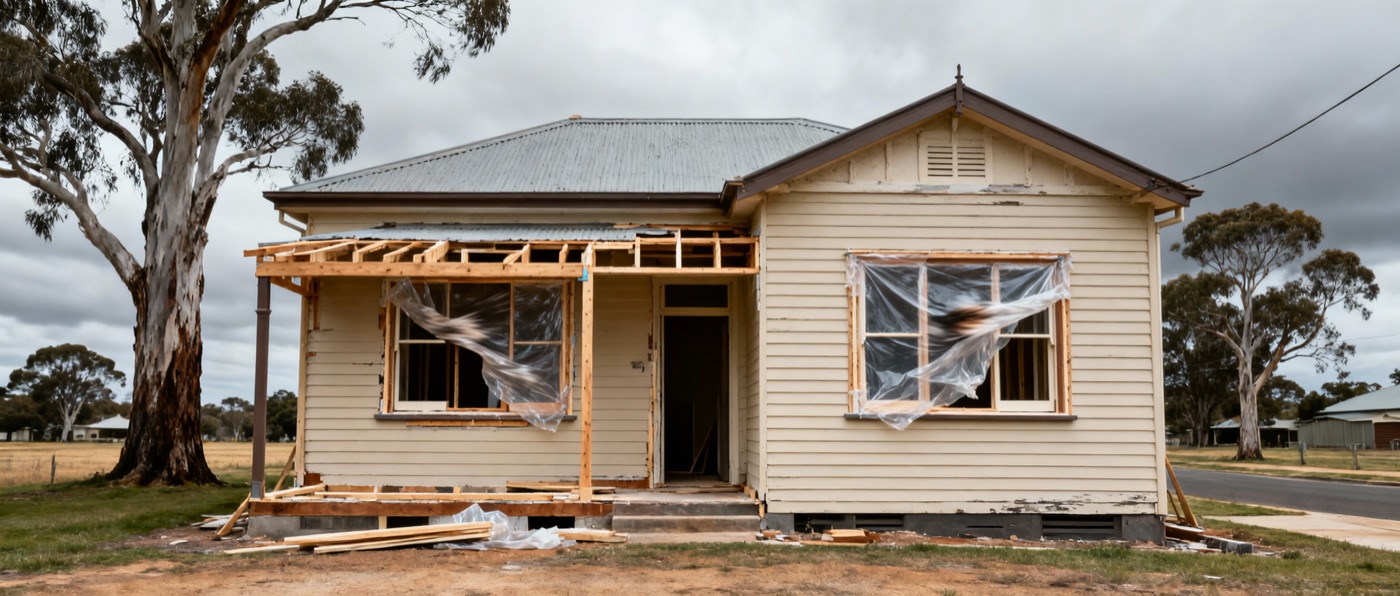
The work was poor: windows and walls were left unsealed, the house was open to wind and rain, and it was unliveable. To save on relocation costs, the mum had to live apart from her children and her dog. She paid another builder $11,000 to fix the work, and took out a second mortgage.
He pleaded guilty to 3 charges in the Bairnsdale Magistrates Court. Two of them: carrying out domestic building work without the required registration, and without the required domestic building insurance. With costs, the total came to more than $32,000.
What the magistrate said, in effect: these offences, particularly the lack of insurance, cannot be understated and must be met with consequences and deterrence.
The fine was his to pay. The house, the repair bill and the second mortgage all stayed with the owner.
"I'm insured" is only half the story
First, the true half. From 1 July 2026, Victoria switched to a new insurance called Home Warranty, provided by the BPC itself, replacing the old domestic building insurance (DBI). For contracts signed from 1 July, work over $20,000 on homes up to three storeys must have it.
What's better about it? Before, you could only claim if the builder went insolvent, disappeared or died. Under the new scheme, you can apply even while the builder is still trading, if the work is incomplete, defective or non-compliant.
If work hasn't started and your deposit is lost, part of it may be claimable. If delays or rework force you to move out for a while, some accommodation, removal and storage costs may also be covered. What you actually get depends on the BPC's assessment.
Now the other half. There's one sentence on the BPC website every owner should read:
What the BPC says, in effect: if you use an unregistered builder for work that must be done by a registered builder, Home Warranty does not protect you.
In other words, the insurance follows the registration. Hire the wrong person and that safety net was never there.
I call it "Ten grand, check the person. Twenty grand, check the paper"
Ten grand, check the person. In Victoria, for work over $10,000 the builder must be registered with the BPC. A single-trade job (only tiling, only painting, only glazing, say) doesn't need this registration. But if several trades are combined, or the work needs a building permit (restumping or demolishing a house, for example), registration is required whatever the price. Electricians and plumbers have their own licences.
How to check: go to the "Find and check a practitioner" page on the BPC website and search by name or registration number. You'll see their licence, registration, and disciplinary and prosecution history.
Twenty grand, check the paper. For jobs over $20,000, the builder pays the premium, and the deadline is whichever comes first: 10 business days after the contract is signed, or the day work starts. Once it's paid, the BPC issues the owner a Notice of Cover.
When it arrives, check these:
Notice of Cover in hand: match it against your contract
- Is the builder's name the same as on the contract?
- Can the registration number be found on the BPC website?
- Is the ABN or ACN correct?
- Is the site address your home?
- Does the work covered match the work in the contract?
- Cover start date and claim timeframes
- If anything doesn't match, contact the BPC as soon as possible
The website also makes this point: Home Warranty is a statutory scheme, so even if the builder doesn't pay the premium, owners of eligible work may still be protected. But not paying is itself an offence. So if the notice never arrives, don't just let it go. Ask.
Over ten grand, check he's registered. Over twenty grand, check the Notice of Cover.
What about contracts signed before 1 July?
They stay with the old DBI and don't move to Home Warranty. That scheme's threshold is $16,000, and it's the one that applied to the Bairnsdale job.
It matters when you sell, too: a buyer can pay $51.80 to request an Insurance Information Statement from the BPC, showing whether a Notice of Cover was issued for work at the property from 1 July. So keep that piece of paper with your contract, plans and payment records.
Why so many of us fall into this
First, we treat insurance as an optional extra. Back home, "building insurance" for renovations is rarely heard of. When a tradie says "skip it and it's cheaper", plenty of people nod.
Second, we only check for an ABN. An ABN means he can issue invoices. It doesn't mean he's registered with the BPC.
Third, we treat the deposit as a show of good faith. The Bairnsdale job asked for 50%; the legal cap was 5%. Someone asking for a big chunk up front is a warning sign in itself.
We've connected each state government's licence register to a free little tool, hometradie.com. Describe the job in your own language, say "replace windows and fix water damage in an old Melbourne house", and it tells you whether the job needs a licence or registration, and lets you check the number on the spot.
The same line to finish: over ten grand, check he's registered. Over twenty grand, check the Notice of Cover.
Data note: all policy figures in this article were re-checked on official websites on 2026-11-10. Bairnsdale case (aged 60, East Gippsland Home Projects, quote of more than $84,000 to repair water damage including windows, 50% deposit requested when the maximum was 5%, unsealed windows and walls leaving the home unliveable, owner living apart from her children and dog, $11,000 paid to another builder for repairs, second mortgage, guilty pleas to 3 charges including unregistered work and no domestic building insurance, fined more than $32,000 including costs, the magistrate's words, the $10,000 registration and $16,000 DBI thresholds): BPC media release of 2026-05-06, "Unregistered builders on notice after Bairnsdale man convicted and fined $32,000 over a home renovation". Home Warranty applying to contracts signed on or after 1 July 2026, replacing DBI with existing policies not transferring, over $20,000, up to three storeys, up to $400,000 per home, major defects up to 6 years after completion and other defects 2 years, possible cover for lost deposits where work has not started and for accommodation, removal and storage costs, no protection when an unregistered builder does work requiring registration: BPC "Home Warranty" page (updated 2026-06-30). Claims possible while the builder is still trading, previously limited to insolvency, disappearance or death: Consumer Affairs Victoria, 2026-06-23, "New protections for homeowners set to build", and the vic.gov.au "Better domestic building insurance" page (updated 2026-10-27). Premium paid by the registered builder by the earlier of 10 business days after signing or work starting, Notice of Cover issued by the BPC to the owner and the items to check, owners may still be protected if the builder does not pay and non-payment is an offence, Insurance Information Statement fee of $51.80: BPC "Home Warranty premium and Notice of Cover" page (updated 2026-06-30). Registration required with the BPC for work over $10,000, single-trade exemptions, registration required regardless of value for multi-trade work or work needing a building permit: Consumer Affairs Victoria, "About builders, tradespeople and other building practitioners" (updated 2025-12-12). The search page showing licence, registration, disciplinary and prosecution history: the same BPC media release. The quote and conversation at the start are an illustrative scenario. This article covers Victoria only; other states have different rules. This is not legal advice; for your own project, consult a licensed professional.
· Check a licence number for free (against the government register, no sign-up)
· Describe your job in a sentence — we show whether it needs a licence in your state and what the quote should spell out
· Post your job and get a link for any tradie — they reply without signing up, and you read the reply in your own language