A $2,400 hot water job, and the plumber says "Let's skip the certificate, I'll knock a bit off." In Victoria, that piece of paper is your 6 years of insurance
Other languages: 中文 · Tiếng Việt · العربية
Your hot water system has been going for well over a decade, and it's finally stopped giving you hot water. You find a plumber. Unit plus install, he quotes $2,400. Job done, you ask him for the paperwork.
He waves it off: "The certificate costs me extra and the forms are a pain. Let's skip it, I'll do you a better price."
Sounds like he's saving you money.
Don't nod just yet. Let me ask you one question: what exactly is that piece of paper he wants to "skip"?
In Victoria it's called a Compliance Certificate. It isn't a receipt. It's two things: first, a licensed plumber signing off that the work complies; second, confirmation that the work is covered by insurance for 6 years.
In the words of Victoria's regulator, the BPC: a compliance certificate confirms the plumbing work complies with the regulations, and confirms the work is covered by insurance for 6 years.
"Small jobs don't need a certificate" — only half true
First, the true half. Not every plumbing job needs this certificate. Fixing a small leak or swapping a washer is low value, and Victoria's rules genuinely don't require one.
Now the wrong half. Victoria draws the line very precisely:
That total counts labour, materials, the hot water unit itself and GST, all together, no matter who bought the unit. If you bought the hot water system online yourself and only paid him to install it, the cost of the unit still counts.
A $2,400 hot water job like the one above is well past that line. So "hot water systems don't need a certificate" doesn't stand up in Victoria.
There's an even firmer rule: gas work doesn't depend on price. The official page says installing, relocating or replacing a gas appliance needs a certificate whatever it costs, and so does changing gas piping. Below-ground sewer drains are the same, regardless of value.
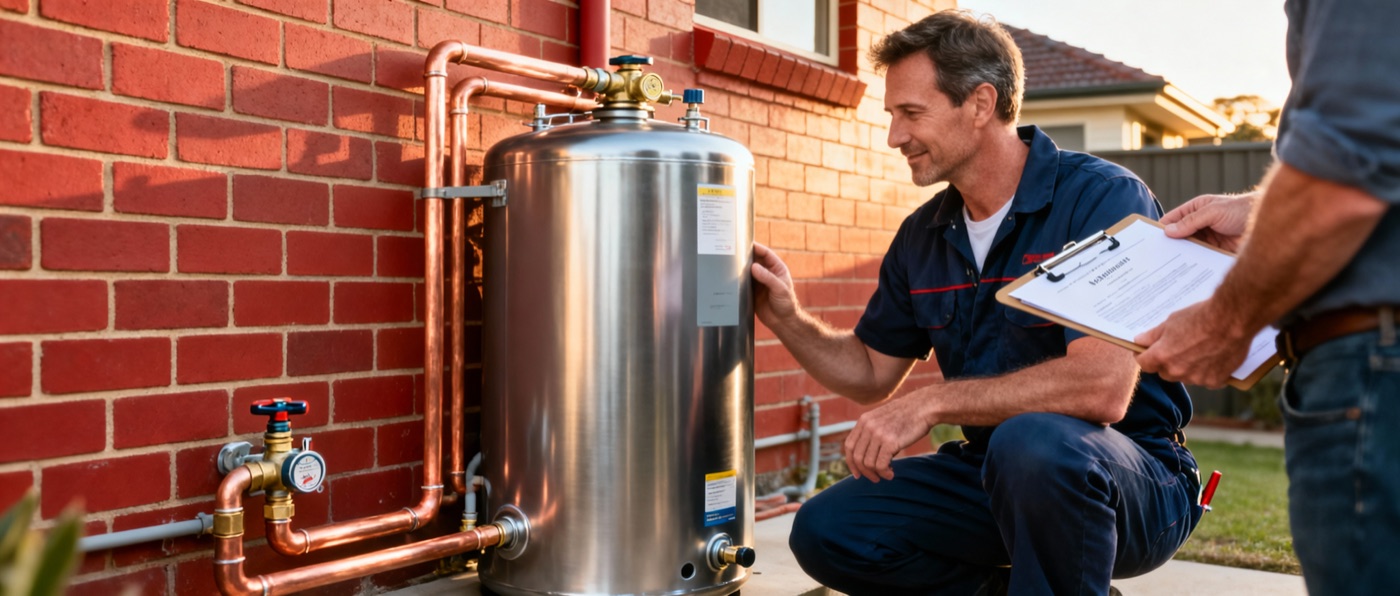
I call it "one piece of paper, two layers of protection"
Layer one: compliance. Only a licensed plumber can sign a certificate. The official page says a registered plumber can't sign one, and can only work under a licensed plumber's supervision. Their signature means that person is responsible for the work.
Layer two: insurance. For work that needs a certificate, the licensed plumber must hold insurance. It covers the cost of fixing defective work, and non-completion, including when the plumber dies, disappears, goes insolvent or has their licence cancelled. Cover runs from the day they agreed to do the job until 6 years after the certificate is issued.
The official page says: even if the plumber stops operating or retires, the insurance should continue for those 6 years.
So when he says "let's skip the certificate, I'll knock a bit off", the little bit you save is traded for your one path to insurance if something goes wrong in the next 6 years.
You paid for the hot water system. The certificate is your insurance. Don't let anyone quietly skip it.
This isn't scaremongering: a penalty from 2026
On 29 July 2026, the BPC announced a penalty: a licensed plumber was fined more than $21,000 including costs.
The facts in the announcement: on drainage work across several Melbourne suburbs and Geelong, he booked mandatory inspections but didn't turn up, or the drains weren't ready when the inspection time came; at 7 of the 8 sites, he let people do work that didn't comply; the work spanned 4 years. At Port Melbourne, he failed to provide a compliance certificate within 5 days of completing the work.
Even a licensed plumber gets fined for not handing over the certificate. An unlicensed one can't issue it at all.
What about NSW? No dollar line — every plumbing job needs a licence
If you're in Sydney, the rules are different, but they point the same way, and they're stricter:
NSW Fair Trading's words: a licence is required for all specialist work such as electrical, plumbing and air conditioning, regardless of the cost.For other residential work, a licence is only needed above $5,000.
The NSW Government site also says: at the completion of all plumbing and drainage work, the plumber must fill out a Certificate of Compliance and give a copy to the person who arranged the work, meaning you or your builder. Replacing an existing hot water system counts as "minor works", so no notice is needed before starting, but the compliance certificate at the end is still owed to you.
Before you replace a hot water system, go in this order
One checklist to get both the certificate and the insurance
- Before work starts: check the licence on the government register; in Victoria, confirm they're at the Licensed level and in the right class
- When quoting: ask "Will you give me a compliance certificate when it's done?" and get it written into the quote
- Gas hot water: in Victoria a certificate is required whatever it costs, so don't accept "small jobs don't need one"
- After completion: in Victoria you should have the certificate within 5 days; in NSW you should get a copy at completion
- Keep the certificate, invoice, quote and photos in one folder. That's your proof for the 6 years of insurance
What if you don't get a certificate? The Victorian official page says that if you didn't receive a certificate you were owed, you can complain to the BPC on 1300 067 088. The BPC can assess complaints about plumbing work done within 10 years of the certificate date or completion date (provided the plumber is still licensed).
Why we're so easy to "skip"
First, we treat the certificate like a receipt. Back home, once a hot water system works and you've got the installer's number, that's the end of it. In Australia, that certificate is tied to insurance.
Second, it feels like doing the plumber a favour and saving ourselves money. He has to buy the certificate and lodge the forms, so of course he'd rather skip it. But what he saves is his hassle. What you lose is your protection.
Third, we can't tell licensed from registered. Victorian plumbers come in two levels, and only the licensed level can sign certificates. "Plumber" on a business card doesn't mean they can sign this piece of paper.
We've connected each state government's licence registers to a free little tool, hometradie.com. Tell it in your own language what job you need done, say "replace a gas hot water system", and it tells you whether that job legally needs a licence, and lets you check a licence number on the spot.
So, one last time: You paid for the hot water system. The certificate is your insurance. Don't let anyone quietly skip it.
Data statement: All policy figures in this article were re-checked on official websites on 2026-10-27. Compliance certificates must be issued by a licensed plumber; registered plumbers cannot issue them; a certificate is required where the total value (including labour, materials, appliances and GST, regardless of who purchased them) exceeds $750 (the BPC home owner page and media release say "$750 or more"); installing, relocating or replacing gas appliances, consumer gas piping and below-ground sanitary drain work need a certificate regardless of value; the certificate must be given to the customer and lodged with the BPC within 5 days of completion — Building and Plumbing Commission (BPC, formerly VBA) "Plumbing compliance certificates" page (updated 2026-07-09). The certificate confirms 6 years of insurance; cover runs from when the plumber agreed to do the work until 6 years after the certificate is issued; cover should continue if the plumber stops operating or retires; scope of cover; you can complain if you didn't receive a certificate; the BPC can assess complaints about work within 10 years; phone 1300 067 088 — BPC "Plumbing insurance" page (updated 2026-07-23). Penalty case (fine plus costs of more than $21,000, 7 of 8 sites non-compliant, over 4 years, no certificate within 5 days at Port Melbourne) — BPC media release of 2026-07-29, "BPC reminds plumbers of drainage inspection requirements after plumber hit with maximum fine". In NSW a licence is needed for specialist work regardless of cost, and for other residential work above $5,000 — NSW Fair Trading notice "Do not deal with Duanne Hevers". In NSW all plumbing and drainage work needs a Certificate of Compliance at completion with a copy to the person who arranged the work, and replacing an existing hot water system is minor work that doesn't need a Notice of Work — NSW Government "Plumbing inspection documents" page. The $2,400 quote and conversation at the start are an illustrative scenario. If the hot water system involves electrical connection, a licensed electrician is also needed. This article covers Victoria and NSW only; other states have different rules. This article is not legal advice; for a specific project, consult a licensed professional.
· Check a licence number for free (against the government register, no sign-up)
· Describe your job in a sentence — we show whether it needs a licence in your state and what the quote should spell out
· Post your job and get a link for any tradie — they reply without signing up, and you read the reply in your own language