You beat the price down to $6,500 and felt like a winner. What you'd really cut was your own insurance
Other languages: 中文 · Tiếng Việt · العربية
You've got three quotes for a bathroom renovation: $9,800, $8,200 and $6,500. You picked the cheapest, haggled for half an hour and got it down to $6,000. You'd even worked out the caption for your social media post: money saved is money earned.
Hold off on celebrating. Let me ask you one question: how can he quote 30% less than everyone else?
Anyone in business knows that within Sydney, materials cost everyone the same and hourly labour rates are no secret. There's only one place a 30% saving can really come from: the cost structure. A licensed tradie has to earn the licence, keep it renewed, pay for compulsory insurance and stand behind your job with a statutory warranty of up to six years. All of that costs money. For someone without a licence, every one of those costs is zero.
An unlicensed operator can always quote the price you most want to hear, because the costs he skips are exactly the ones that save your skin when things go wrong.
You think it's a battle of wits between you and him. In fact, the outcome was decided the moment the quote was printed. You're comparing three numbers. What you should be comparing is the line that isn't on the quote at all: the licence number.
This isn't a scare story. The case is right there on a government website
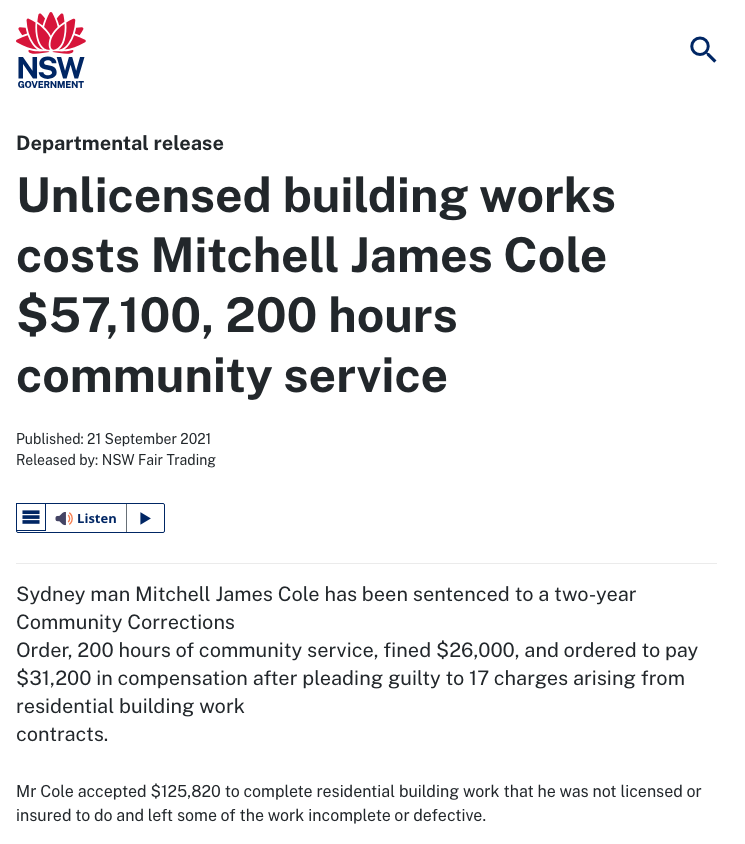
A Sydney man named Mitchell James Cole did work for four Sydney homeowners between 2018 and 2019 and collected $125,820 from them: interior renovations, a balcony extension, gutter repairs, a pool renovation and a glass pool fence.
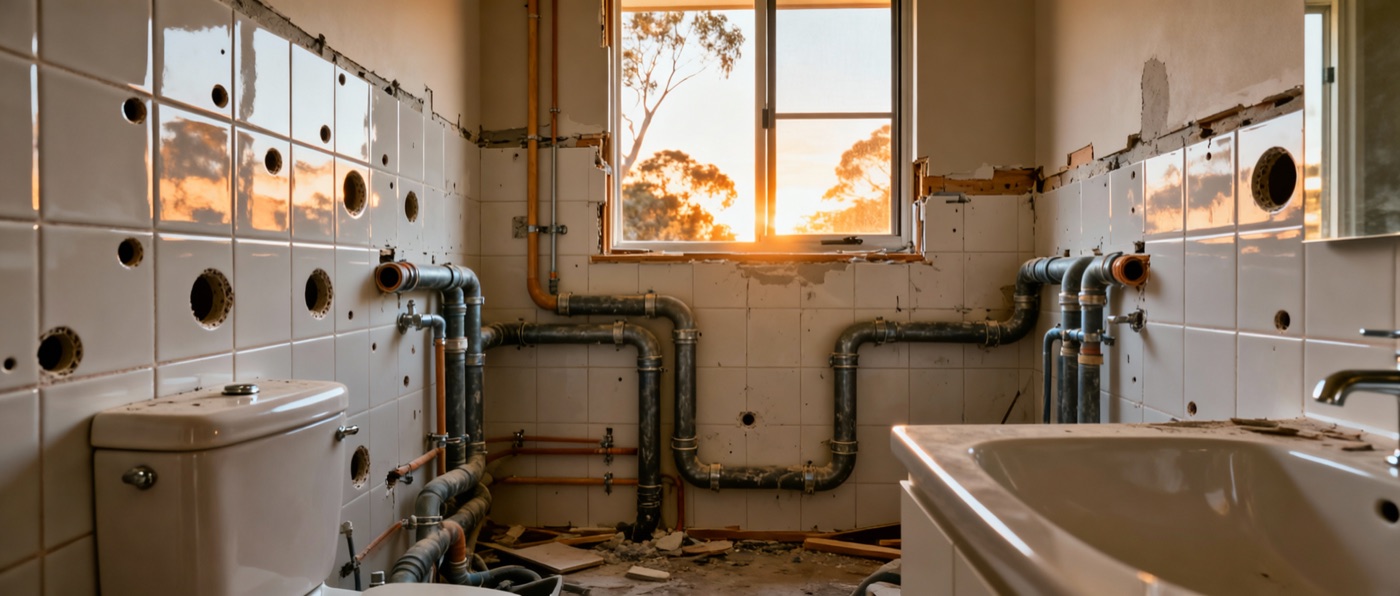
And how did the work turn out? External cladding abandoned halfway, a roof that wasn't up to standard, water-soaked ceilings, gutters installed but not connected, downpipes that didn't catch any water. The most vivid was the pool fence job: he drilled 22 holes in the ground, then left without installing a single panel.
From start to finish, this man never held a building licence of any kind. Not for a single day.
The court's decision: he pleaded guilty to 17 charges. He was fined $26,000, ordered to pay $31,200 in compensation and to do 200 hours of community service, and given a two-year community correction order. Note the compensation figure. The four homeowners paid out $125,820; the court ordered $31,200 back. The other $90,000-plus will most likely never come back.
The fine is the government punishing him; it has nothing to do with you. Your money is protected by the three things below, and hiring someone unlicensed means giving up all three at once.
Unlicensed work doesn't just fail on quality. It takes out three safety nets
In NSW, for residential work costing more than $5,000 in labour and materials, the person doing the work must be licensed. That's the law, not a suggestion. Specialist trades such as electrical, plumbing, gas and air conditioning are even stricter: no matter how small the job, even a one-dollar job needs a licence. Replacing a light fitting or fixing a tap both count.
Last year, a local Sydney homeowner had someone replace eight downlights for $600. The man doing it had been "recommended by a friend, does great work". What the owner didn't know: a licensed electrician is required to give you an electrical compliance certificate after the job, and someone without a licence can never issue one. When you make a home insurance claim, the insurer is entitled to investigate what caused the damage, and unauthorised wiring changes with no compliance certificate could become grounds for rejecting the claim. A $600 job, with the insurance policy on your whole home riding on it.
Doing work without a licence carries a maximum fine of $22,000 for an individual and $110,000 for a company. That's what he faces. Here's what you face:
Hire someone unlicensed and all three fall away
- Statutory warranty: it still exists in law (it binds anyone who was required to hold a licence), but there's no insurance behind it, and once he's gone there's no one to claim from
- Compulsory insurance: in NSW, jobs over $20,000 must have HBCF insurance, and an unlicensed operator simply can't buy it
- Getting your money back: in a dispute you have to chase it yourself through NCAT (the NSW Civil and Administrative Tribunal), and winning doesn't mean you'll be paid
If the job goes wrong, the warranty is still there on paper, but there's no insurance behind it. If you can't find him, it's an IOU from no one, and all that's left is chasing him yourself through the tribunal. How much do you get back? You've already seen the ratio in the Cole case: a quarter.
There's one more layer many people never think about: the statutory warranty goes with the house, not with you. If you do a licensed renovation today and sell a couple of years later, the next owner can still make a claim while the warranty period is running, and that's a plus when you sell. On the flip side, a buyer's building inspector can spot unlicensed, unapproved work at a glance. At best, the buyer pushes the price down; at worst, they ask you to pay to fix it before the sale goes through. The same renovation money, spent the licensed way, adds value to your home. Spent the unlicensed way, it buries a landmine in it.
Haggling saves you a few hundred dollars. A licence saves you tens of thousands.
Let's finish the maths from the start. You chose $6,500 and haggled it down to $6,000, saving $3,800 compared with the $9,800 licensed quote. That's the part you can see. The part you can't: if the job goes wrong, going by the recovery ratio in the Cole case, you'd get back about $1,500 of the $6,000 you paid, a net loss of $4,500. The botched work would then have to be redone by someone licensed, so you'd spend $9,800 all over again. Add the two together: $14,300. That's nearly four times the $3,800 you "saved", and that's not counting the year of your time it eats up.
Win the bet and you save $3,800. Lose it and you're out more than $14,000. What do people in business call that? A deal with negative expected value.
Why newcomers like us keep getting caught
First, language. Ringing a government agency in English to check a licence number makes a lot of people nervous before they even start, so in the end they don't bother.
Second, the friend-of-a-friend culture. We're used to "a friend recommended him, so he's reliable". A local Sydney homeowner once told me his backyard job was done by a tradie his neighbour had recommended. The neighbour's only basis for it: "He's done work for me, nice guy." Being a nice guy and holding a licence are two completely unrelated things. The person who recommended him had never checked either.
Third, many people don't even know that checking is a thing. The NSW Government keeps every licence on a public register that anyone can search for free. But you have to know the $5,000 line exists before it even occurs to you to check.
The bottom line: if you grew up somewhere with no $5,000 line, where home renovation crews don't need a government licence, you arrived in Australia with the muscle memory of "find someone you know, compare prices". That habit works back there. Here, it comes with a tuition fee, and the price list is written in the Cole case above.
Flip the order: check credentials first, then talk price. It doesn't cost a cent, and it fills in the biggest hole you could fall into.
Ask these three things before work starts, and you've already won
Three things before work starts
- Ask for the licence number and ABN and check them against the government register on the spot; the licence class must cover your job
- For jobs over $20,000, see the HBCF insurance certificate first; no certificate, not one cent paid
- Get a written quote that spells out whether materials are included, how many days the job will take and who takes the rubbish away; a verbal quote is no quote at all
Asking these three questions isn't rude at all. A genuine licensed tradie wants you to check, because once you do, the gap between him and the unlicensed quote finally becomes easy to explain. Only the people who can't afford to be checked complain that you ask too many questions.
We've recently connected the state governments' licence registers to a free little tool at hometradie.com that works like this: describe the job you need done in one sentence, in your own words, and it tells you straight away whether that job needs a licence under the rules in your state and what the quote should spell out. You can check a licence number on the spot too. Checking costs nothing.
Sources and notes: All policy figures in this article were re-checked on 2026-08-27. The NSW licensing threshold of $5,000 (including GST, labour plus materials) for residential building work, and the maximum penalties of $22,000 for an individual / $110,000 for a company: NSW Government "General building work" page. Specialist trades (electrical, plumbing, gas, air conditioning) must be licensed regardless of job value: NSW Government "Categories and classes of building and trade work" page. Compulsory HBCF insurance for jobs over $20,000: official icare / SIRA guidance. The statutory warranties bind both licence holders and anyone required to hold a licence: Home Building Act 1989 (NSW), section 18B (re-checked against the Act on 2026-09-26, correcting this article's earlier statement that they don't apply to unlicensed work). Claims involving unlicensed contractors can go straight to NCAT without a Fair Trading investigation: NCAT "Home building" page. The Mitchell James Cole case ($125,820 received; guilty pleas to 17 charges, 16 under the Home Building Act and 1 under the Australian Consumer Law; $26,000 fine; $31,200 compensation; 200 hours of community service; two-year community correction order; the announcement of the outcome was published in September 2021): official NSW Fair Trading media release. This is a public case, and the details of the person involved are taken from the original government announcement. The quote comparison at the start and the downlight example are illustrative scenarios. The statements about electrical compliance certificates and insurer investigations describe general principles; the terms of your own policy apply. This article is not legal advice. For your specific project, please consult a licensed professional.
· Check a licence number for free (against the government register, no sign-up)
· Describe your job in a sentence — we show whether it needs a licence in your state and what the quote should spell out
· Post your job and get a link for any tradie — they reply without signing up, and you read the reply in your own language