He slid off a shed roof 3.4 metres up. The person who hired him wasn't a building company. It was the home owner
Other languages: 中文 · Tiếng Việt · العربية
A site in NSW where a shed is going up. A 34-year-old worker loses his footing on the roof and falls from about 3.4 metres. He is seriously injured. A workmate reaches out to grab him and ends up with minor injuries himself.
SafeWork NSW, the state's workplace safety regulator, wrote this up in an incident release dated 29 February 2024. One line in that release matters more to home owners than the fall itself:
The two injured workers, plus a third worker on the site, hadn't been sent by a building company. They had been engaged by an owner-builder, that is, a home owner acting as their own builder.
SafeWork goes on: under work health and safety law, an owner-builder owes the workers they engage the same safety duty as a person running a business.
Plenty of people think of owner-builder as a "save money" permit. Read the government pages and it looks more like a "transfer of responsibility" form.
You cut out the builder's margin. You take on the builder's responsibility
First, what an owner-builder actually is.
In NSW, if the work on your home needs a DA or CDC (the kind council or a certifier has to approve), the reasonable market cost of labour and materials is over $10,000, and you're not contracting a licensed builder to supervise it but hiring the workers and running the site yourself, you need an owner-builder permit before you start.
The sums most people do go like this: the builder charges a management fee and a margin, so if I manage it myself, I keep that money.
That's half right. You may well keep the money, but everything the builder was carrying when he charged it lands on you, all of it.
The NSW Government page puts it this way: the permit is not a builder's licence, but an owner-builder is just as responsible for the building work as a fully licensed builder would be.
The list on the page: overseeing and supervising all tradespeople, ordering materials and managing the site, getting every approval, meeting the tax and insurance requirements, keeping the site safe, making sure every contractor you engage is licensed and insured, and warranting that the materials and work are fit for purpose and the dwelling can be lived in.
I call this "same hat, different head": the builder's hat hasn't gone anywhere. It has just moved from his head to yours.
The builder's hat hasn't gone anywhere. It has just moved onto your head.
Not everyone can get this permit, and it doesn't let you do everything
The lines for an NSW owner-builder permit
- The work is over $10,000 and needs a DA or CDC: only then do you need, and only then can you apply for, this permit
- Over $20,000, you first have to complete 5 set units of competency, or hold an approved equivalent qualification
- You must be at least 18, hold a white card (general construction induction training), and be the owner or joint owner of the land, or hold a registered lease of 3 years or more
- You must intend to live there once the work is finished; no permit for renovating an apartment, unit or townhouse in a strata complex
- Generally only one permit in any 5 years, unless it's the same land or special circumstances apply
Two spots here trip people up all the time.
First, an investment property that is fully rented out. The page says that once the work is done you must intend to live in the house, or in one of the dwellings. If you live somewhere else and the whole property is let, using this permit to add onto it doesn't fit that condition. Dual occupancy is tighter again: the page says a permit is only issued in special circumstances.
Second, assuming the permit lets you do any work yourself. Electrical, plumbing and drainage, gasfitting, and air conditioning and refrigeration: these four have to be done by a licensed person whatever the job costs. The permit doesn't cover them unless you hold that licence yourself. For other trades, anyone doing work worth more than $5,000 (labour and materials) has to be licensed too, and you need a written contract with them.
Don't get creative on the application form either. The page states that false or left-out information can be prosecuted under the Crimes Act: up to 2 years in prison, or a fine of up to $22,000, or both.
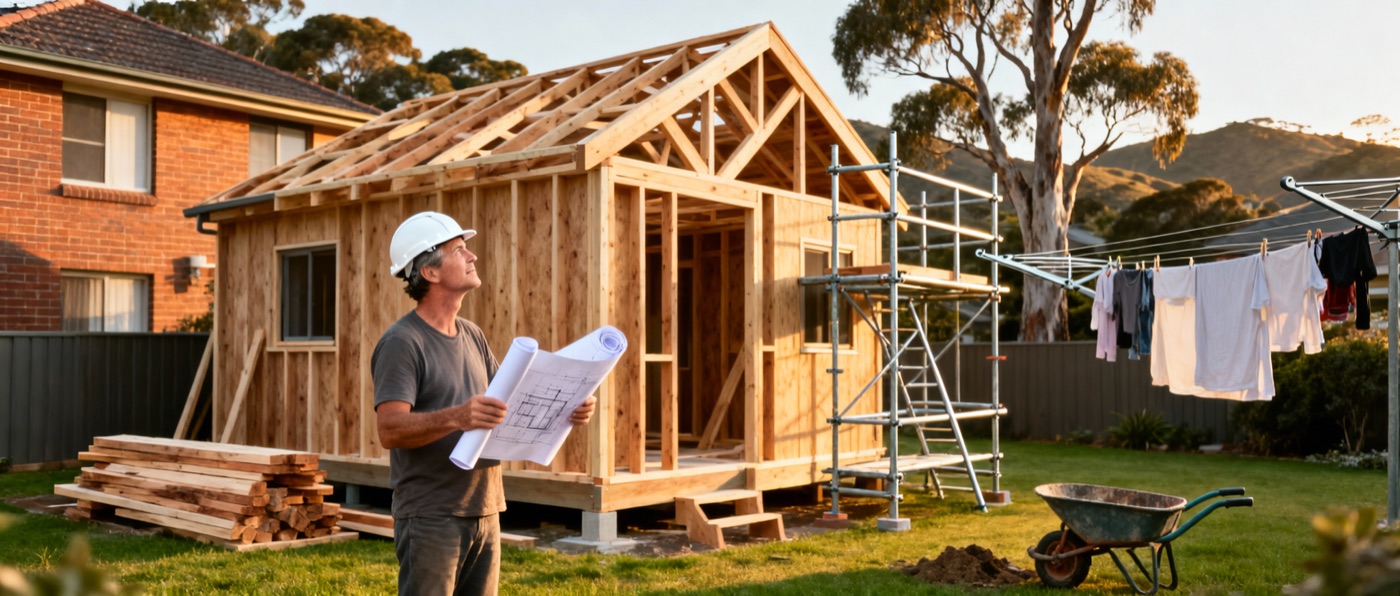
A granny flat out the back is the most common owner-builder job. You can see what other people's finished granny flats look like and what they cost on SeeBuilds: https://seebuilds.com/au/zh/works?category=granny_flat
Knowingly hire someone unlicensed and the fine is yours
For a lot of owner-builders, the next move is finding the cheapest people. A mate recommends a bloke who "can do anything". No licence, and a fair bit cheaper than the licensed ones.
The Home Building Act has a provision aimed squarely at owner-builders. It is an offence for a permit holder to do any of the three things below, and the maximum penalty on the government page is $22,000:
Three red lines for permit holders (maximum penalty $22,000)
- Knowingly engaging an unlicensed contractor
- Lending your permit to another person
- Refusing to give an authorised officer the names and addresses of the contractors working on your site
Some people will say to a home owner: "You go and get an owner-builder permit, put it in your name, I'll do the whole job, it'll be cheaper." If he's unlicensed and you know it, that's the first line crossed. The name on the permit is yours, and when something goes wrong, you're the one they come to.
Back to that site at the start. In its release, SafeWork sets out a string of things an owner-builder should make sure of: you and your workers hold white cards, everyone who comes on site gets a site induction, high-risk work has a written Safe Work Method Statement, and if the risk of falls can't be eliminated, you put up scaffold or temporary roof guard rails.
Normally the builder does all of that. As an owner-builder, you do.
One layer less insurance, one extra line when you sell
On insurance the page is blunt: home building compensation cover (HBCF) is no longer available for work done by an owner-builder.
Only part of the job is covered: each licensed builder or tradesperson who contracts directly with you, where the contract price is over $20,000, must take out this cover for their own part of the work. The page says you should receive the certificate of insurance before work starts and before you pay any money.
For the rest, the law doesn't require this cover.
The page also strongly recommends owner-builders take out their own public liability policy: you own the land, so if a family member or a passer-by is injured because of the building work, you could be liable. And if you're hiring people, find out whether you need workers compensation insurance.
Selling takes an extra step as well. If you sell within 7 years and 6 months of the permit being issued, the contract for sale has to include a consumer warning stating that an owner-builder permit was issued for the land. Leave it out and the buyer can void the contract before settlement.
And the warranty goes with the house. The page uses a WARNING in capitals: you are guaranteeing the work you undertake, the next immediate owner gets the benefit of the statutory warranties, and they can take you, the owner-builder, straight to NCAT (the NSW Civil and Administrative Tribunal).
Why people from our communities are so quick to go down this path
First, back home, running your own job is simply how renovating works. You buy the materials, you find the electrician, the tiler and the carpenter, you keep an eye on the site. Nobody thinks twice. In NSW, do the same thing on a job over $10,000 that needs approval, and you need the permit first and the responsibility comes with it.
Second, only the saving gets counted. A builder's price includes management, insurance and warranty, costs you can't see. Run it yourself and those costs don't disappear. They turn into your time and your risk.
Third, someone you know says "just put it in your name". It sounds like he's saving you money. In fact a responsibility that was never yours is being put under your name.
Before you decide to be an owner-builder, ask yourself three things
Before you sign
- Can I really run this job: approvals, site safety, and every worker's licence and insurance are all mine now
- Have I checked every person's licence on the government register; written contract for work over $5,000, certificate of insurance in hand first for anything over $20,000
- Will I sell this place within 7 years and 6 months: the contract has to say so, and the warranty follows me
Owner-builder isn't off limits. If you've got the skills, the time and you know your way around a site, it can work. Before you start, you can look up your own block on SeeBuilds: https://seebuilds.com/au/zh/block
We've connected each state government's licence register to a free little tool, hometradie.com. Tell it in your own language what work you need done and it will tell you whether that job needs a licence under the rules, and you can check a licence number on the spot. If you're going owner-builder, check every person before you hire them.
One more time: you cut out the builder's margin, and you take on the builder's responsibility.
Data note: every policy figure and incident fact in this article was re-checked on NSW Government websites on 2026-10-14. The shed roof fall (a 34-year-old worker seriously injured after slipping and falling about 3.4 metres from a shed roof; a second worker sustaining minor injuries trying to grab him; the two injured workers and a third worker all engaged by an owner-builder; owner-builders having the same duty as a person conducting a business or undertaking (PCBU) under the Work Health and Safety Act 2011; white cards, site inductions, SWMS for high-risk construction work, and scaffold or temporary roof guard rails): SafeWork NSW incident information release "Worker seriously injured on owner-builder worksite (29 February 2024)". The release does not mention any prosecution or penalty, and this article does not say there was one. NSW owner-builder permits: a permit is needed where the reasonable market cost (labour and materials, including GST) is over $10,000 and the work needs a DA or CDC; over $20,000 requires 5 units of competency or an equivalent accreditation; applicants must be at least 18 and hold a white card; must be the owner, joint owner, a shareholder in the company that owns the land, or hold a registered lease of at least 3 years; must intend to live in the dwelling after completion; no permit for renovations to an apartment, unit or townhouse in a strata complex; dual occupancy only in special circumstances; generally one permit in any 5 years: NSW Government page "When an owner-builder permit is needed". False or misleading applications, up to 2 years' imprisonment or a maximum fine of $22,000 or both: NSW Government page "How to apply for an owner-builder permit". Owner-builders being as responsible as a licensed builder, and the list of responsibilities; specialist work (electrical, plumbing and drainage, gasfitting, air conditioning and refrigeration) needing a licence regardless of cost and not being allowed under the permit; trades over $5,000 needing a licence and a written contract; the maximum penalty of $22,000 for a permit holder who knowingly engages an unlicensed contractor, lends the permit, or refuses to disclose contractors' names and addresses to an authorised officer; home building compensation cover no longer being available for an owner-builder's own work, while a licensed contractor contracting directly must provide it where the contract price is over $20,000; the recommendation to take out public liability insurance and to check workers compensation obligations; the consumer warning required in the contract when selling within 7 years and 6 months of the permit being issued, failing which the purchaser can void the contract before settlement; and the next owner being able to enforce the statutory warranties at NCAT: NSW Government page "Working as an owner-builder". The "put it in your name" conversation is an illustrative scenario. This article covers NSW only; other states have different rules. It is not legal advice. For a specific project, talk to a licensed professional.
· Check a licence number for free (against the government register, no sign-up)
· Describe your job in a sentence — we show whether it needs a licence in your state and what the quote should spell out
· Post your job and get a link for any tradie — they reply without signing up, and you read the reply in your own language