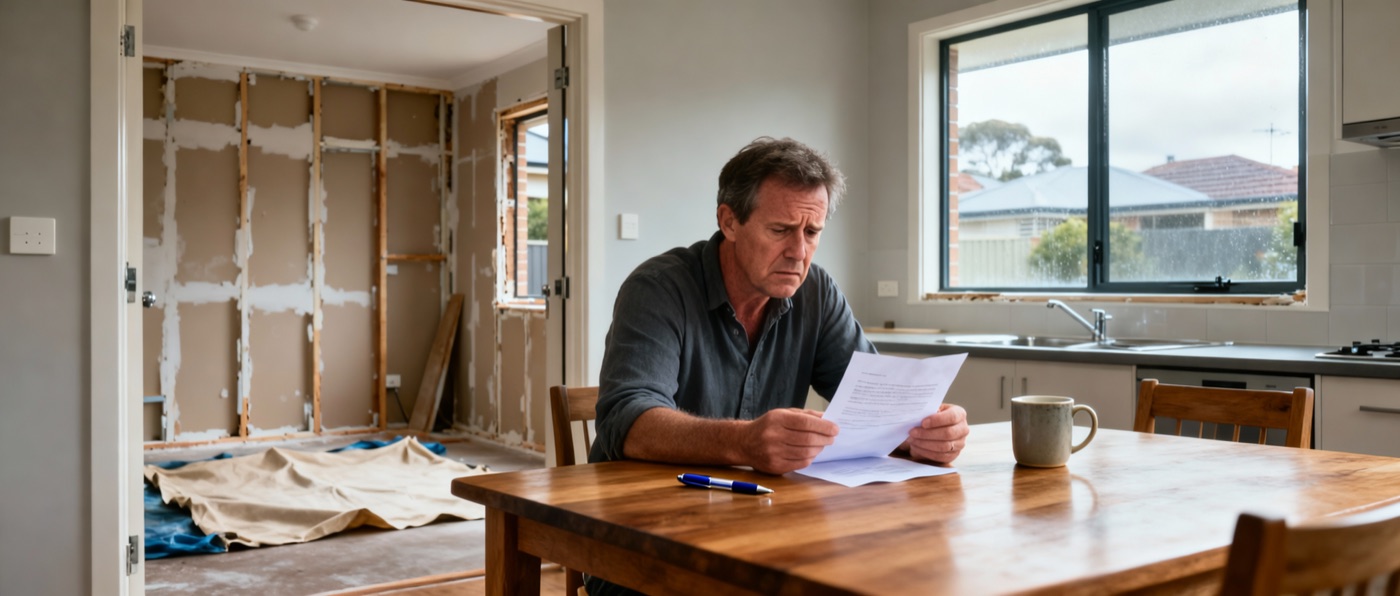
Ten days in, he says there's rock underground and it's $8,000 extra. You check the quote: not one word about it
Other languages: 中文 · Tiếng Việt · العربية
Halfway through ripping out your bathroom, the tradie sends you a message: there's rock underground, he'll need an extra rock breaker, and it's another $8,000.
You're a bit stunned, but you can't put your finger on what's wrong. He sounds like he knows what he's talking about. You dig out the original quote and read it from top to bottom. About what's underground, about rock, about what happens if they can't dig through: not a single word.
So can you refuse to pay?
Don't start the argument just yet. First, a question that comes before that one: how many lines were on that quote in the first place?
"I've got a written quote, in black and white." That's only half right
Start with the half that's right. You're ahead of most people: at least you got something in writing. Plenty of people still start work on a figure mentioned over the phone or in a voice message.
Now the half that's wrong. A quote isn't a contract. A quote is a few lines he wrote.
What's the difference? A contract is a document the law says must exist and must contain enough detail, and if it falls short, he's breaking the law. A quote has no such rules: it can be as short as he likes.
And here's a rule almost everyone gets backwards:
The shorter the quote, the more room there is for the price to go up.
A quote that just says "Bathroom renovation $8,200" looks neat and tidy. But it also means: is demolition included? Not stated. Which brand of tiles? Not stated. Who takes away the old tiles and materials? Not stated. What if they hit rock? Not stated.
Every gap is a blank cheque he can fill in with a number later.
Why the cheapest quote is so often the one with the fewest words
This isn't my guess. It's something the NSW Government itself says on its website. On its page for homeowners about getting quotes, it says:
If you don't make clear what you want at the start, the quote may only include the cheapest products and materials.
Read that slowly. It isn't saying "he'll rip you off". It's saying: if you don't specify, he'll quote the cheapest. Commercially, that makes complete sense; competition practically forces it. When three businesses quote for the same job, whoever guesses a higher spec ends up with the highest total, and is out of the running.
So here's the truth:
You think you're comparing three prices. You're actually comparing who's willing to write down the lowest standard.
That's why quotes for the same bathroom can be 30% apart without any of the three lying. They weren't answering the same question in the first place.
One step that can save you tens of thousands: the same brief for everyone
The fix on that government page is simple, so simple it hardly sounds like a fix: write your own brief for the job first, then send that same brief to at least 3 contractors.
I call this the same-brief rule: only when all three are answering the same question are you comparing prices. If they're answering three different questions, all you're comparing is word counts.
The brief doesn't need to be polished; a few dot points will do. Of the tips on that official page, two are worth the most:
First, write down brands and models. Taps, tiles, toilet, light fittings, appliances: whichever one you want, write it down. If you don't, you'll get a price for the cheapest one, and if you want to swap it when it's time to install, that's a variation.
Second, spell out who cleans up. Who takes the rubbish away, who deals with the old materials, who cleans up before completion. It sounds minor, but removing the building waste from a bathroom job isn't cheap in Sydney, and it's the item most likely to turn into "that wasn't included" once work has started.
A quote you can actually compare must spell out at least these six lines
- What: every piece of work itemised, not just "bathroom renovation" in one line
- With what: brands and models of the main materials; don't accept wording like "or equivalent"
- In or out: demolition, rubbish removal, painting, cleaning, temporary water and power, each marked as included or excluded
- How much: an itemised price, not just one total. A total can't be checked; line items can be compared
- How long: start date, completion date, and how delays are handled
- Who signs: the licence holder's name, licence number and ABN, all three matching the register
Don't skip that last line. The party that signs the contract must be the same party that holds the licence. We covered this in detail in our previous article, so we won't repeat it here.
The piece of paper the law actually recognises is the contract
A quote is something you negotiate over. A contract is what the law governs. In NSW, the line is clearly drawn:
If the job price is more than $5,000 (including GST), or the price isn't set but the reasonable market cost of labour and materials is more than $5,000, there must be a written contract.
And there are two tiers of contract: jobs between $5,000 and $20,000 use a small jobs contract, and jobs over $20,000 must use a large job contract.
A large job contract isn't just "a bit longer". It's a document the law specifically says must include a set of things. Nine out of ten homeowners I come across don't know about some of them:
One: a cooling-off period. A contract over $20,000 must state, in clear wording, that you have a cooling-off period of five clear business days after you receive a copy of the contract.
Write that one down. Signing doesn't lock you in on the spot. Plenty of people sign at a dinner table, in a display home, or on the strength of a "sign today and get a discount" line, then go home, feel worse the more they think about it, and assume it's too late.
Two: a checklist, and a warning. A large job contract must come with a checklist, and it must state this warning: if you can't answer "yes" to any item on the checklist, don't sign the contract. The government requires that line to be printed in the contract. It's not some feel-good advice I made up.
Three: a progress payment schedule. A contract over $20,000 must have a schedule of progress payments, and the government stresses the same point in two places:
Progress payments must match the work actually completed, not how long he's been at your place.
Four: the booklet. For residential building work over $5,000, the law requires the contractor to give you the Consumer Building Guide before you sign the contract. If he hasn't given you one, that's a warning sign in itself.
Back to that $8,000: variations have rules
Now to answer the question from the start. Charging $8,000 more because there's rock underground is what the industry calls a variation. Variations themselves are normal; nobody can guarantee what's under the ground. But variations come with rules:
Rule one: it must be in writing and signed by both parties. A message saying "OK to add $8,000?" and you replying "yep" is not a variation document.
Rule two: it must spell out where the money comes from. This is the one most people don't know. The document authorising the variation must state its effect on cost and on the total contract price, and should set out how the price change was calculated, rather than just handing you a single total.
So when that "extra $8,000" message comes in, the question to ask isn't "can you do it cheaper?" It's: for this $8,000, how many days of the rock breaker, how much per day, how many labour hours, how much in materials? Please write it out for me to sign.
A genuine variation, he can write out. One made up on the spot, he can't.
Rule three: if the rework is needed because of his own mistake, you don't pay. The cost of any extra work caused by his own fault shouldn't land on you.
A genuine price increase comes with the calculation. A made-up one only comes with a total.
Deposit limits are different in each state, so don't just copy one
Finally, deposits. This is the one part of the whole article where getting it wrong means losing cash straight away.
In NSW: the deposit can't be more than 10% of the contract price. Note that it's 10% for both large and small contracts, with no exception tier.
But if you're in Victoria or Queensland, copying that 10% means handing over far more than you should:
Victoria: up to 10% for contracts under $20,000; up to 5% for $20,000 and above. Queensland: up to 20% for $3,300 or less; up to 10% for $3,301 to $19,999 (level 1 contracts); up to 5% for over $20,000 (level 2 contracts). (Queensland has one exception: where a large amount of custom-made or prefabricated components are made off-site and make up more than half of the total contract price, the deposit can be up to 20%.)
Take a $300,000 contract: the cap is $30,000 in NSW, and $15,000 in Victoria and Queensland.
There's one rule that's even firmer than the percentages. In NSW, for jobs over $20,000 that need home building compensation (HBC) insurance, it's illegal in itself for the contractor to ask you for a deposit or any payment at all before they've taken out the insurance and given you the certificate.
The order is fixed: see the certificate first, then pay the deposit. Not "pay the deposit first and he'll go and sort out the insurance".
A case the government named: by the time the warning came, the money had already been paid
On 11 March 2022, NSW Fair Trading issued a public warning naming a man called Anthony Francis (who also used the names Tony Francis and Anton Francis). It said he was operating around Sydney's Hills District at the time, first taking on concreting jobs and later moving into fencing.
In the announcement, the Fair Trading Commissioner said consumers had complained that after signing contracts and taking their money, he would either leave the work half done or not start at all, and then keep the money.
Fair Trading had charged him with 14 offences under the Home Building Act, including contracting for and doing residential building work without a licence, taking a deposit of more than 10% of the contract price before work started, and taking payment before obtaining the required home warranty insurance. There were also 2 charges under the Australian Consumer Law. To be clear, these are charges, not court rulings.
What struck me most in the announcement wasn't the charges. It was the small print at the very end: Fair Trading had already issued a public warning about him back in September 2018.
The government will name names. But by the day it does, the homeowners who came before have long since paid.
Public warnings are for the people who come after. What you have to rely on is the ten minutes before you sign.
Why newcomers like us keep tripping up at this step
First, in our muscle memory, a quote is a contract. Many of us are used to renovations that kick off with just a quote and a money transfer, and run on who you know and on goodwill. Not here. Here, what a contract must say is written into law, and if you don't use it, the law just sits there doing nothing for you.
Second, we're afraid of looking difficult. Asking for every brand and model to be written in, asking for the calculation behind a variation, asking to see the insurance certificate first: plenty of people are fine with the idea but can't get the words out, worried the tradie will think "this client is hard work". But a tradie who runs a legitimate business wants you to put it all in writing, because once it's in writing, the difference between him and the people quoting lower can finally be spelled out.
Third, the lure of a big deposit works in reverse. Many people offer to pay a bigger deposit, thinking it'll make the tradie care more or bump them up the schedule. The real effect is the opposite: every dollar of deposit you pay over the limit is a length of safety rope you've cut yourself. Once the money has gone over the line, you've got no cards left to play.
Before you sign or pay anything, get these four things done
From quote to payment, don't get the order backwards
- Write a brief for the job and send the same one to at least 3 contractors: without the same brief, there's no real comparison
- Get an itemised quote with brands and models for the materials, and demolition, rubbish removal, painting and cleaning each marked as included or not
- Jobs over $5,000 need a written contract; for jobs over $20,000, remember the cooling-off period of five clear business days, and if you can't answer "yes" to any item on the checklist, hold off signing
- Deposits depend on your state: capped at 10% in NSW, and at 5% above $20,000 in Victoria and Queensland; on jobs over $20,000, see the HBC insurance certificate before you make the first payment
None of these four things costs a cent, and you don't need great English. There's only one hard part: asking these questions at the stage when work hasn't started, everyone's getting along and the tradie is all smiles.
We've recently turned this into a free little tool at hometradie.com that works like this: describe the job you need done in one sentence, in your own words, and it tells you whether that job needs a licence under the rules in your state and what the quote should spell out. You can check a licence number right there too.
The same caveat as before, upfront: for NSW, the tool connects directly to the government's live register, so what you see is the current status. For some states, what we have is a data extract published by the government. It can tell you whether someone is on the register, but that doesn't mean the licence is still valid today. When that's the case, the page says so clearly and gives you the official government link so you can check again yourself.
Sources and notes: All policy figures and case facts in this article were re-checked against state government websites on 2026-09-22. NSW: the written contract threshold (a contract price over $5,000 including GST, or, where the price isn't set, a reasonable market cost of labour and materials over $5,000 including GST); small jobs contracts for $5,000–$20,000 and large job contracts for over $20,000; the requirement for a large job contract to state a cooling-off period of five clear business days after receiving a copy of the contract; the requirement to attach a checklist with a warning not to sign if you can't answer yes to any item on it; the requirement for a progress payment schedule, with progress payments matching work actually completed rather than time on site; the cap of 10% of the contract price on deposits; the rule that, for work requiring HBC insurance, asking for a deposit or any payment before the insurance is obtained and the certificate provided is illegal; the requirement for variations to be in writing and signed by both parties, with the variation document stating the effect on cost and setting out how the price change was calculated (rather than giving a single figure); and the rule that homeowners don't pay for rework caused by the contractor's own fault: NSW Government "Contracts for residential building work" page. The requirement to provide the Consumer Building Guide before signing for residential building work over $5,000, along with the 10% deposit cap and the requirement for variations to be signed by both parties: NSW Government "Consumer Building Guide" page. The advice to write a description of the work first and send the same information to at least 3 contractors; that contractors should provide a written quote listing all the work and all the materials, in line with the owner's specifications; that if the owner doesn't make their requirements clear at the start, the quote may only include the cheapest products and materials; and to check that the materials quoted are what the owner wants rather than substitutes: NSW Government "Getting quotes for contractors" page. Victorian deposit caps (10% for contracts under $20,000, 5% for $20,000 and above): Consumer Affairs Victoria "Deposits and payments for building work" page. Queensland deposit caps (20% for $3,300 or less; 10% for $3,301–$19,999 level 1 contracts; 5% for level 2 contracts over $20,000; and the exception of up to 20% where custom-made/prefabricated components made off-site account for more than 50% of the total contract price): QBCC "Deposits and progress payments" page. Everything in the Anthony Francis (also known as Tony Francis and Anton Francis) section, namely the public warning published on 11 March 2022, the comments of Fair Trading Commissioner Natasha Mann, the 14 charges under the Home Building Act (including contracting for and doing residential building work without a licence, taking a deposit of more than 10% of the contract price before work started, and taking payment without home warranty insurance), the 2 further charges under the Australian Consumer Law, and the earlier public warning in September 2018, is from the original NSW Fair Trading announcement "Consumers urged to avoid unlicensed contractor". That announcement describes charges, not court decisions, and this article makes no statement about their outcome. The deposit cap comparison for a $300,000 contract is calculated directly from the official percentages above. The bathroom price-rise scenario at the start is illustrative. This article is not legal advice. For your specific project, please consult a licensed professional.
· Check a licence number for free (against the government register, no sign-up)
· Describe your job in a sentence — we show whether it needs a licence in your state and what the quote should spell out
· Post your job and get a link for any tradie — they reply without signing up, and you read the reply in your own language