Your renovated bathroom starts leaking in year 3. The tradie says "12-month warranty, it's over." The law gives you 6 years
Other languages: 中文 · Tiếng Việt · العربية
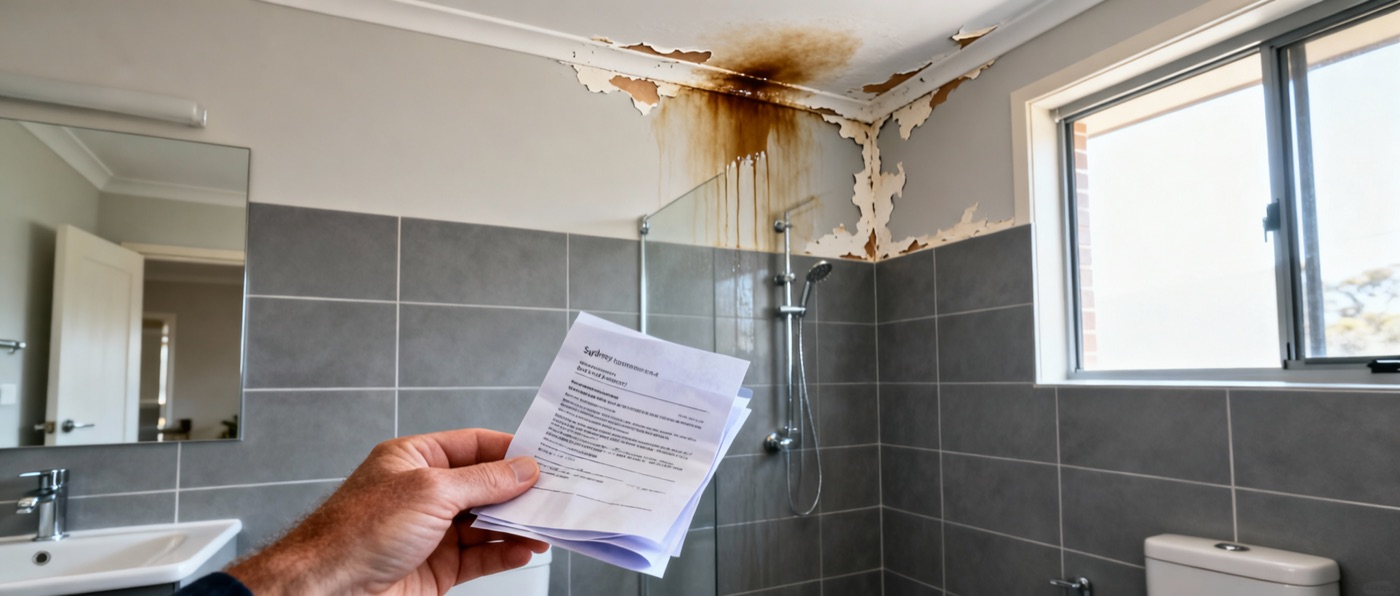
Your bathroom was renovated the year before last. This winter, a yellow ring slowly spreads across the ceiling downstairs, a bit bigger every week. You dig out the old quote. At the bottom, one line: Warranty: 12 months.
You ring the tradie. He's polite, and very clear: "Mate, warranty was one year. That's long gone. Happy to fix it, but it's a new job, new quote."
You hang up and figure you'll just have to wear it.
Don't wear it yet. Let me ask you one question: who decided on those 12 months?
He did. On his own quote. But in NSW, residential building work comes with a second warranty ledger. He didn't write it, the law did, and no contract can change it.
In the NSW Government's own words: these statutory warranties cannot be excluded or overridden by a contract.
"The warranty's expired" is only half true
First, the half that's right. The warranty period in the contract is real. It's an extra promise the tradie makes himself: if something goes wrong in that window, he comes back and fixes it, usually without an argument. In new-home contracts it's called the defects liability period, and the government says it's usually 13 weeks for new homes.
Now the half that's wrong. When the contract period runs out, the warranty the law gives you is still there.
I call this "two warranty ledgers":
Ledger one is the contract. It lasts as long as the tradie writes: 12 months, 13 weeks, whatever.
Ledger two is the law. It comes straight from the Home Building Act 1989. It doesn't need to be in the contract, and a shorter period written into the contract doesn't count. The government states that all residential building work in NSW, including renovations, comes with a statutory warranty.
Both periods run from the day the work is completed (for contracts signed on or after 1 February 2012).
Why a leaking bathroom may fall in the 6-year category
The statutory warranties cover these things: the work is done with due care and skill, it follows the plans and specifications, the materials are suitable and generally new, it complies with the Home Building Act and other laws, it's finished in a reasonable time, and the result is fit for purpose.
Whether it's 6 years or 2 depends on whether it's a major defect.
The government's definition: a major defect is a defect in a major element of the building, caused by defective design, workmanship or materials, or by failing to meet the structural requirements of the National Construction Code (NCC). The examples of major elements it lists are three: load-bearing parts (such as foundations and walls), fire safety systems, and waterproofing.
So if the bathroom waterproofing wasn't done properly and water is getting into the floor below or into the walls, badly enough to affect normal use, it may fall in the 6-year major defect category. Not every leak is a major defect, and which category it is will ultimately be decided by an inspector or the tribunal looking at the actual site. But at the very least, "the one year is up" doesn't shut you out.
The contract warranty is something he gives you. The statutory warranty is something nobody can take away.
One more layer: the warranty stays with the house. The government states that if the home is sold during the warranty period, the protection stays with it, and the next owner can claim too.
6 years doesn't mean "any time". Miss the line and it's gone
The law gives you a long time, but there's a hard line.
In the government's words: it is the home owner's responsibility to apply to the Tribunal (NCAT) before the statutory warranty period expires. After that, Building Commission NSW and the Tribunal may not be able to deal with it.
There is one extension: if the problem only became apparent in the last 6 months of the warranty period, you get an extra 6 months after the period ends to start proceedings.
The government also warns: even if you're already going through the Building Commission complaint process, if the warranty period is nearly over, you should lodge an application with NCAT at the same time to protect your rights.
Once you spot a problem, go in this order
- Take photos, note the date, and tell the tradie in writing first (email or letter); keep a copy
- Agree how it'll be fixed and by when, and confirm that by email too
- If you can't agree, contact Building Commission NSW on 13 27 00; you can ask for an inspection, and if the inspector finds defects a Rectification Order can be issued
- If the job has HBCF cover (work over $20,000), notify the insurer in writing as soon as you find the problem
- If the warranty period is nearly up, don't wait: lodge an application with NCAT
Why so many of us just "wear it"
First, we treat the words on the quote as the whole rulebook. Back home, how long a renovation is guaranteed for is mostly whatever the renovation crew writes down. In NSW, the contract is only ledger one. The legal ledger exists whether it's written down or not.
Second, the tradie sounds so sure. He says "one year's long gone" with total confidence, and a lot of the time he genuinely believes it. Sounding sure isn't the same as being right.
Third, we wait. With a leak, plenty of people put up with it for one winter, then keep an eye on it through summer. The 2-year category can't survive that kind of waiting, and even the 6-year one leaves you on the back foot if you leave it to the last half year.
One thing before the job, one thing after
Two small habits that protect the legal ledger
- Before the job: anything over $5,000 needs a written contract with the tradie's name, licence number and the scope of work; check the licence on the government register before you sign
- After the job: write down the completion date, take a set of photos, and keep them in one folder with the contract and invoices; that date is the starting point for your 6 years and 2 years
Kitchens and bathrooms are the most common renovations, and the ones most likely to show problems a few years later. You can see what other people's finished kitchen and bathroom renovations look like, and what they cost, on SeeBuilds: https://seebuilds.com/au/zh/works?category=kitchen_bath
We've connected every state government's licence register to a free little tool, hometradie.com. Tell it in your own language what job you need done, and it tells you whether that job legally requires a licence, and you can check a licence number on the spot. If something goes wrong and you need to chase someone, it had better be someone you can actually find on the register.
So, one last time: the contract warranty is something he gives you. The statutory warranty is something nobody can take away.
Data note: all policy figures in this article were re-checked against NSW Government websites on 2026-10-20. Statutory warranty of 6 years for major defects and 2 years for other defects (for contracts signed on or after 1 February 2012, running from completion); problems that become apparent in the last 6 months of the period allow an extra 6 months after expiry to start proceedings; applying to NCAT before the warranty period expires is the home owner's responsibility; after expiry Building Commission NSW and the Tribunal may be unable to deal with it; definition of major defect and examples of major elements (load-bearing components such as foundations and walls, fire safety systems, waterproofing); steps after finding a problem (notify the contractor in writing, confirm the agreement in writing, ask Building Commission NSW to assist, notify the HBCF insurer in writing, apply to NCAT) — NSW Government "Resolving building disputes with your builder or tradesperson" page and Building Commission NSW "How Building Commission NSW deals with building defect complaints" page; Rectification Orders issued by an inspector where defects, incomplete work or damage are found — same pages; all residential building work in NSW (including renovations) comes with statutory warranties, they cannot be excluded or overridden by a contract, protection stays with the home if sold during the warranty period, defects liability period usually 13 weeks for new homes, notify the builder of defects in writing and keep a copy, enquiries on 13 27 00 — NSW Government "How to make sure your new building work remains trouble-free" page; the content of the statutory warranties (due care and skill, following plans, suitable and generally new materials, compliance with the law, timely completion, fit for purpose) and that they apply even if not written into the contract — NSW Government "Contracts for residential building work" page; written contract required over $5,000 (including GST), HBCF cover required over $20,000 — same page and Building Commission NSW page. The leaking bathroom and "12-month warranty" at the start are an illustrative scenario; whether a particular defect is a major defect or another defect is for an inspector or NCAT to decide. This article covers NSW only; other states have different rules. This is not legal advice; for a specific project, consult a licensed professional.
· Check a licence number for free (against the government register, no sign-up)
· Describe your job in a sentence — we show whether it needs a licence in your state and what the quote should spell out
· Post your job and get a link for any tradie — they reply without signing up, and you read the reply in your own language